Choosing between a Programmable Logic Controller (PLC) and a Distributed Control System (DCS) is one of the most consequential decisions in any automation project. Both platforms handle real-time control, but they are optimised for fundamentally different environments. Getting this wrong costs plants years of workarounds and migration budget.
Quick Answer
Choose a PLC for discrete, machine-level, or packaging applications where scan speed, I/O density, and cost matter. Choose a DCS for continuous process plants – refineries, chemical facilities, power stations – where integrated process management, advanced alarming, and multi-loop coordination are non-negotiable.
Architecture: The Core Difference
A PLC is a standalone controller. It executes a scan cycle – reading inputs, running logic, writing outputs – typically in 1-20 ms. Multiple PLCs in a plant communicate via industrial Ethernet (EtherNet/IP, PROFINET) but each unit is independently engineered.
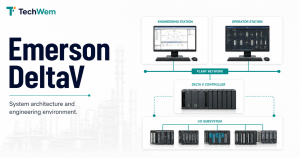
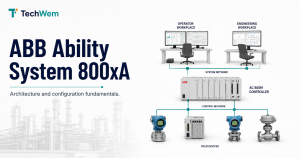
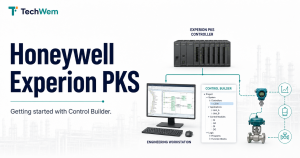
A DCS is a distributed system by design. Controllers, I/O modules, historian, operator stations, engineering workstations, and alarm servers are all integrated into a single vendor ecosystem. Honeywell Experion PKS, Emerson DeltaV, ABB 800xA, and Yokogawa CENTUM VP are dominant platforms. The system shares a unified database – a tag defined once is available everywhere, from the controller to the historian to the HMI.
When to Choose a PLC
- Discrete manufacturing: automotive assembly, packaging lines, conveyor systems, injection moulding – high-speed, event-driven logic with many digital I/O points.
- Machine-level control: a single machine or production cell where each unit is self-contained and does not require plant-wide process integration.
- Small-scale applications: water pumping stations, HVAC control, small utilities with a limited number of control loops.
- Cost-sensitive projects: PLCs from Allen-Bradley (ControlLogix, CompactLogix), Siemens (S7-1500), or Mitsubishi cost significantly less per I/O point than DCS equivalents.
- High-speed requirements: motion control, press lines, and packaging require deterministic scan times well under 5 ms – PLCs with motion controllers handle this natively.
When to Choose a DCS
- Continuous process plants: oil refining, petrochemicals, LNG, pharmaceuticals, pulp and paper, power generation. These plants run 24/7 with thousands of interdependent control loops.
- Advanced process control (APC): model predictive control (MPC), cascade loops, and feed-forward schemes are native to DCS platforms. Implementing the same on a PLC requires custom software and significant engineering.
- Integrated alarm management: ISA-18.2-compliant alarm rationalisation, shelving, suppression, and historical analysis are built into DCS platforms. PLCs require third-party SCADA or historian integrations.
- Redundancy requirements: DCS platforms offer controller redundancy, I/O redundancy, and communication redundancy as standard options – critical for SIL 2/3 loops in process safety applications.
- Large I/O count and geographic distribution: a refinery may have 50,000-200,000 I/O points distributed across multiple process units. DCS remote I/O subsystems handle this with lower engineering overhead than a PLC network.
Key Technical Comparison
| Factor | PLC | DCS |
|---|---|---|
| Primary use | Discrete / machine | Continuous process |
| Scan time | 1-20 ms typical | 100-500 ms typical |
| I/O integration | Per-controller | System-wide unified |
| Historian | Third-party required | Built-in |
| Alarm management | Via SCADA/HMI | ISA-18.2 native |
| Redundancy | Optional, vendor-specific | Standard offering |
| Upfront cost | Lower | Higher |
| Engineering effort (large plants) | Higher | Lower |
The Grey Zone: Hybrid Installations
Modern plants increasingly run hybrid architectures. A refinery might use a DCS (Honeywell Experion or Emerson DeltaV) for all process control, while PLCs (Allen-Bradley ControlLogix) handle packaged equipment – compressor skids, pump packages, fire and gas systems – that arrive from vendors pre-configured. The DCS integrates with these PLCs via OPC UA or Modbus TCP, pulling data into the unified historian and HMI.
SCADA systems occupy another tier, typically providing supervisory visibility across multiple PLCs or DCS systems across geographically distributed sites (pipelines, water networks, power substations).
The Bottom Line
If your plant runs batch or continuous processes with hundreds of PID loops, complex interlock logic, and a requirement for integrated alarming and process data history – a DCS pays for itself in engineering efficiency and uptime. If you are automating a single machine, a packaging line, or a small utility system where cost per I/O point and scan speed matter – a PLC is the correct and proven choice.
When in doubt, map your I/O list, identify whether your control strategy is predominantly discrete (on/off) or modulating (PID), and count your loops. That analysis, not brand preference, should drive the decision.
Related Reading
Total Cost of Ownership: The Real Comparison
Initial hardware cost is just one component of the TCO equation, and often not the dominant one. Consider the full lifecycle:
- Engineering cost: DCS platforms typically include a rich library of pre-built function blocks for loops, device control, and sequences. A PLC system requires more custom programming to achieve equivalent functionality. For a 2,000-loop continuous process plant, engineering cost for a DCS is often 20-30% lower than the equivalent PLC system.
- Commissioning time: DCS systems with centralised configuration databases and auto-discovery of I/O reduce commissioning time. PLC systems with distributed, project-file-per-controller architecture require more coordination during commissioning.
- Maintenance: PLCs use standardised hardware that is easy to source and replace, often from multiple vendors. DCS hardware is proprietary, but vendors typically guarantee spare parts availability for 15-20 years.
- Support costs: DCS vendors offer comprehensive support contracts that cover hardware, software, and engineering support. PLC systems from multiple vendors (controller, HMI, historian, batch) require separate support contracts from each vendor.
Hybrid Architectures: The Best of Both
The cleanest answer for many modern facilities is a hybrid architecture: DCS for continuous process control, PLCs for machinery and high-speed discrete applications, connected via OPC UA or EtherNet/IP into a unified supervisory layer. This approach is increasingly common in pharmaceutical facilities (DCS for process vessels, PLCs for packaging lines), food and beverage plants (DCS for mixing and pasteurisation, PLCs for filling and labelling), and power plants (DCS for boiler and turbine control, PLCs for BOP equipment).
The integration layer is the key engineering challenge in hybrid architectures. Define the interface points between DCS and PLC clearly: which system owns the process historian, which system provides the operator interface for each section, and how alarms from the PLC environment flow into the DCS alarm management system.
Platform-Specific Considerations
Market position varies by industry and geography:
- Refining and petrochemicals: DCS-dominant. Honeywell Experion, Emerson DeltaV, ABB 800xA, and Yokogawa CENTUM are the primary platforms.
- Discrete manufacturing and automotive: PLC-dominant. Siemens S7-1500, Rockwell ControlLogix, Mitsubishi MELSEC dominate.
- Pharmaceutical: Mixed, with a strong move toward DCS (especially DeltaV) for process equipment and PAT (Process Analytical Technology) integration requirements under 21 CFR Part 11.
- Water and wastewater: PLC and SCADA dominant, with DCS used only for the largest water treatment facilities.
Your industry footprint should be a major input into the platform decision — local support engineers, spare parts availability, and operator training resources vary significantly by region and industry.