SCADA (Supervisory Control and Data Acquisition) systems control critical infrastructure from water treatment plants to natural gas pipelines. Their increasing connectivity to enterprise networks and the internet has made them high-value targets for nation-state actors, ransomware groups, and hacktivists.
Top Attack Vectors & Mitigations
| Threat Vector | Risk Level | Primary Mitigation |
|---|---|---|
| Remote access / VPN | HIGH | MFA + jump server |
| USB / removable media | HIGH | Policy + device control |
| Vendor remote support | MEDIUM | Monitored session proxy |
| Unpatched HMI/SCADA OS | HIGH | Patch management + whitelisting |
| Insider threat | MEDIUM | RBAC + audit logging |
| Supply chain compromise | HIGH | Vendor risk assessment |
Why SCADA Security Is Different
Traditional IT security prioritises Confidentiality, Integrity, then Availability (CIA). In SCADA, the priority is reversed: Availability is paramount. A water treatment plant cannot simply take its control system offline to apply a patch. Every security control must be evaluated against its impact on operational availability.
Top SCADA Threats
- Ransomware: Colonial Pipeline (2021) demonstrated that even indirect IT compromise can halt critical OT operations. Modern ransomware specifically targets industrial environments.
- Living-off-the-Land (LOTL) attacks: Attackers use legitimate tools (PsExec, WMI, PowerShell) already present in the environment to move laterally without deploying malware.
- Supply chain compromise: Malicious updates delivered through legitimate vendor channels (SolarWinds 2020, Kaseya 2021 as precedents).
- Engineering workstation compromise: Attacking the engineering workstation gives direct access to controller configuration and safety logic.
- Historian as pivot point: Historians with dual-homed connections to both OT and IT networks are a common lateral movement vector.
Mitigation Framework
- Network segmentation: Implement IEC 62443 zones and conduits. No direct IT-to-OT connections. DMZ for data exchange.
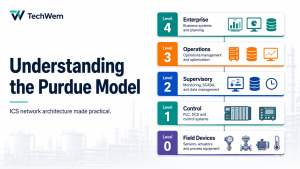
- Remote access control: All remote access via jump server with MFA. Log all sessions. No persistent VPN tunnels to Level 1-2.
- Asset inventory: You cannot protect what you cannot see. Maintain a live OT asset register.
- Patch management: Test patches in a lab environment. Apply critical security patches within 35 days of vendor release (NERC CIP benchmark).
- Vendor access management: Third-party vendors should use managed vendor access solutions, not shared accounts.
- Incident detection: Deploy OT-specific network monitoring (Claroty, Dragos, Nozomi Networks) for passive traffic analysis without disrupting real-time communications.
Incident Response for OT
OT incident response differs from IT: you cannot simply isolate a PLC mid-process. Develop playbooks that define safe operational modes for each incident type, and practice them before an actual incident forces the decision under pressure.
Insider Threats and Human Error
The security conversation around SCADA systems often focuses on external attackers, but insider threats — malicious or unintentional — account for a significant proportion of OT security incidents. Categories of insider threat in SCADA environments:
- Unintentional misuse: An operator accidentally changes a setpoint on the wrong unit; a maintenance technician connects a personal laptop with malware to the engineering workstation network; a contractor loads a USB drive with infected software. These are not malicious but cause real damage.
- Privileged access abuse: A disgruntled employee with administrator access to the SCADA server making unauthorised configuration changes. The risk is elevated during periods of organisational change (layoffs, mergers, contractor demobilisation).
- Social engineering: An attacker impersonating a vendor support engineer convinces an operator to allow remote access or install a software update. SCADA operators who are not security-trained are easy targets for this approach.
Mitigation: role-based access control (minimum required access per role), session monitoring and logging, immediate revocation of access for departing employees, and security awareness training specific to SCADA environments.
Supply Chain Attacks: The Growing Threat Vector
The SolarWinds supply chain attack (2020) demonstrated that trusted software vendors are a vector for nation-state intrusion. In OT environments, the same threat applies to:
- DCS and SCADA software updates distributed by vendors that could be compromised at the source
- Embedded firmware in PLCs, RTUs, and smart field devices from manufacturers with software development practices that do not include code signing or integrity verification
- Third-party libraries and components in OT software that may contain vulnerabilities or malicious code
- Engineering laptops brought on-site by contractors and connected to the OT network, potentially carrying malware from other sites or corporate networks
IEC 62443-2-4 and NERC CIP-013 specifically address supply chain risk. Practical mitigations include: verifying software integrity before installation (hash verification, digital signatures), requiring vendors to attest to their secure development practices, and managing contractor laptop access with network isolation and endpoint scanning before connection to OT networks.
SCADA Vulnerability Assessment
Regular vulnerability assessments are recommended by all major OT security frameworks (NIST SP 800-82, IEC 62443, NERC CIP-010). In OT environments, vulnerability assessment must be performed differently to IT:
- Passive assessment only for live systems: Active scanning (Nessus, OpenVAS) sends network traffic that can crash legacy PLCs, trip watchdog timers, and disrupt SCADA communications. In a live OT environment, only passive assessment tools (Claroty, Nozomi, Dragos) that listen to existing network traffic are safe.
- Configuration review as an alternative: Reviewing switch configurations, firewall rule sets, and SCADA server configurations off-system (exporting configs and reviewing them offline) achieves similar coverage to active scanning without the operational risk.
- Scheduled active assessments during maintenance windows: If active scanning is needed for thorough coverage, schedule it during planned shutdowns when SCADA systems are not actively controlling the process.
Building a SCADA Security Roadmap
A SCADA security programme is not a single project — it is an ongoing capability. A practical roadmap for organisations starting from a low security baseline:
- Year 1 — Foundations: Asset inventory, network segmentation (IT/OT boundary firewall), remove unnecessary remote access, implement patching programme for SCADA workstations, deploy basic network monitoring
- Year 2 — Hardening: Multi-factor authentication for all remote access, role-based access control review, vulnerability assessment programme, incident response plan development and first tabletop exercise
- Year 3 — Maturity: OT-specific SIEM or monitoring platform, supply chain security programme, regular third-party security assessments, security awareness training programme for all OT staff
This is a three-year foundation, not a destination. The threat landscape continues to evolve, and a SCADA security programme must evolve with it. Annual threat intelligence reviews, participation in industry information sharing (E-ISAC, WaterISAC, ONG-ISAC), and engagement with relevant government cybersecurity agencies (CISA, NCSC) keep the programme current.